Pakistan warns UN of terror threat from Afghanistan. urges Taliban action
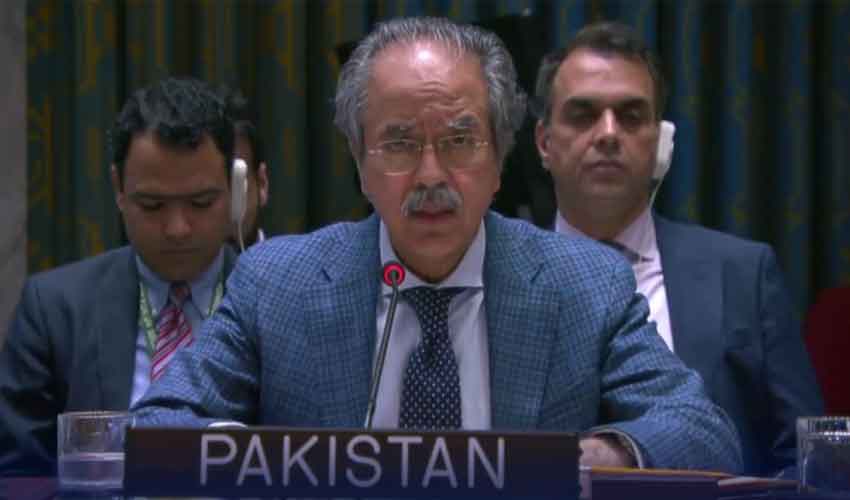
Pakistan has told the UN Security Council that terrorism emanating from Afghanistan remains the “gravest threat” to national security, and urged Taliban authorities across the border to fulfil their international counterterrorism obligations.
“The TTP (Tehreek-e-Taliban Pakistan), with nearly 6,000 fighters, remains the largest UN-designated terrorist group on Afghan soil,” Ambassador Asim Iftikhar Ahmad, Pakistan’s permanent representative to the United Nations, stated during a debate on the situation in Afghanistan.
Pakistan, he claimed, had foiled multiple infiltration attempts by TTP and BLA (Balochistan Liberation Army) terrorists from across Afghanistan, seizing significant caches of sophisticated military-grade modern equipment left behind by international forces in Afghanistan, primarily weapons abandoned by departing US soldiers.
“These efforts come at a heavy price – huge sacrifices by our valiant security forces and civilians,” Ambassador Asim said, referring to the martyrdom of 12 Pakistani soldiers in a single incident earlier this month while defending the border.
“This situation is intolerable,” the Pakistani envoy told the 15-member council.
He claimed that terrorist groups such as ISIL-K, Al-Qaeda, TTP, BLA, and its Majeed Brigade operate from Afghan sanctuaries, with over 60 such terrorist camps serving as hubs for cross-border infiltration and attacks.
“We have credible evidence of collaboration among these terrorist groups through joint training, illicit weapons trade, refuge to terrorists, and coordinated attacks – all aimed at targeting civilian and law enforcement agencies and disrupting and sabotaging infrastructure and development projects in Pakistan.”
He urged swift action on China and Pakistan’s proposal in the UN Security Council’s 1267 Sanctions Committee to designate the BLA and Majeed Brigade as terrorist organizations. The United States has already listed the two terrorist organizations.
Recalling that Pakistan has “consistently advocated sustained engagement with Afghanistan”, Ambassador Iftikhar emphasised that the Taliban sanctions regime should not “fall prey to political considerations of Council members”.
Travel-ban exemption requests, in particular, are still critical for meaningful engagement, he said, citing a recent quadrilateral meeting in Dushanbe between Pakistan, China, Iran, and the Russian Federation, “where we agreed on result-oriented engagement” with Afghanistan’s interim authorities.
He urged international engagement with clear objectives, reciprocal steps, and a “realistic road map guided by dialogue and diplomacy,” emphasizing that isolation and disengagement serve no one’s interests.
He further stated: “Continued restrictions on (Afghan) women and girls are inconsistent with Islamic traditions and norms of Muslim society.”
With the conflict in Afghanistan over, many Afghans who had been hosted by Pakistan for decades have been repatriated in a dignified, phased, and orderly manner, according to the Pakistani envoy.
Pakistan has also implemented a liberal visa regime, allowing a large number of Afghans to legally reside in Pakistan for a variety of reasons, including family ties, education, medical care, and business.
“While we will continue to extend all possible assistance to our Afghan brothers and sisters, the international community must shoulder its responsibility and take the necessary steps to ameliorate the conditions and share this burden more equitably,” he said. “International partners must fulfill their obligations also with regard to their commitments – that are in fact long delayed and unkept – including for third country resettlements.”
Pakistan desires peace and stability in Afghanistan more than any other country, according to the ambassador.
“Pakistan has suffered the most as a result of Afghanistan’s decades-long conflict. We remain committed to supporting a peaceful, prosperous Afghanistan for the sake of our region and the good of the world.”
At the outset, the UN’s outgoing envoy warned that Afghanistan is facing “a perfect storm” of interconnected crises.
Roza Otunbayeva, the secretary-general’s special representative for Afghanistan, told the Council that, while armed conflict in the country has decreased since the Taliban took power in 2021, the humanitarian, economic, and human rights situation has deteriorated dramatically.
“It is an open question whether there is sufficient pragmatism among the de facto authorities [the Taliban] to manage this perfect storm of crises, or whether decisions driven by ideology will prevent sustainable solutions,” she told the audience.
Schools for girls above the sixth grade have been closed for four years, costing the economy an estimated $1.4 billion per year, according to the World Bank. A recent UN Women survey found that the majority of Afghans oppose the bans.
“This is most clear regarding the de facto authorities’ policies towards Afghan women,” she said. “A generation is at serious risk of being lost at a huge long-term cost to the country.”